


You stand on the pedals on a steep, loose climb and pull the bars toward you. The rear wheel takes the whole load of your weight and your power, and for a fraction of a second you can feel whether it holds its shape or gives way sideways. Whether it holds depends on something you cannot see from the saddle: how evenly the spokes on the two sides of the wheel are tensioned. Asymmetric rims exist to fix exactly that.
Why the two sides of a wheel are never equal
On a disc brake wheel, the hub has to leave room for the rotor on one side and the cassette on the other. The result is that the hub flanges sit off-centre, and the spokes on one side come in at a steeper angle than on the other. This is called dish. To reach the same rim position, the spokes on the flatter side must be pulled much tighter than the spokes on the steeper side. On a symmetrical rim there is no way around that.
Tight spokes on one side and relaxed spokes on the other is not a problem when the wheel is new. It becomes a problem under load. The relaxed spokes are the first to go slack when you sprint or corner hard, and a spoke that goes slack again and again fatigues and loosens. That is how a wheel loses its true, and how a rim ends up with a spoke hole under stress.
What an asymmetric rim does about it
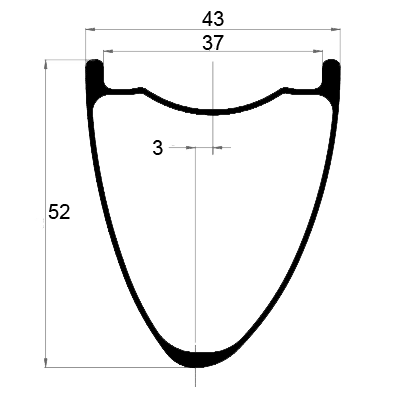
An ART rim moves the spoke holes off the centre line of the rim, towards the side with the relaxed spokes. In our rims the offset is 3mm: to the left at the rear (the disc side) and to the right at the front. That small shift lets the spokes on both sides pull at a more similar angle, so the tension on the two sides moves closer together. We do not have to move the hub flanges closer to the centre to get there, which would narrow the spoke triangle and cost you lateral stiffness. We explain our other design choices in our article on how a 9th Wave wheel is built.
What you notice on the bike
The first thing is stiffness. With more even tension the wheel resists sideways flex better, so the bike follows your steering and your power goes to the road instead of into the wheel. You notice it most when you accelerate out of a corner, in a sprint, or on a loaded bike on a long climb.
The second is durability. Spokes that stay under tension do not fatigue as quickly, so the wheel stays true for longer. We developed ART in mountain biking and it has been tested in the hardest conditions we know, on the beach. 9th Wave was the first brand to invest seriously in beach racing, in 2017, and the same rim principle runs through our road and gravel wheels today. We show how it works on wide gravel rims in our article on 37mm internal width.
Wide, light and hand built
ART works together with a wide internal rim width. A wider rim gives the tire a rounder profile and more support at lower pressure, which means more grip, more comfort and lower rolling resistance. All our rims are built in the light (SL) construction: read what SL and Ninefold mean. And every wheel is hand built in the Netherlands with spoke tension set and checked by a builder, not by a machine alone.
Every 9th Wave rim is covered by a lifetime warranty for the first owner once you register your wheels, and our crash replacement gives you a new rim at 50% off if a crash breaks one. You can see the ART rim in all our wheels, from the Avalon SL3 to the SandStone and the Yarrow SL32.


