

Kilometre 14 of a beach race. The hard sand at the waterline has run out, the course turns up into the soft stuff above the tide line, and the wind comes straight at you. Your tire is at 0.7 bar and you are not riding on the sand any more, you are riding in it. Everything now depends on one question: how deep does the wheel sink, and how much does it cost you to climb out of that groove on every single metre? That is the whole problem of 32 inch beach racing.
Why sand is a different problem from gravel
On a hard surface a tire rolls over the ground. On loose sand the ground gives way under the tire, and the energy that goes into pushing sand aside and compressing it is energy you do not get back. Rolling resistance on sand is therefore mostly a story about sinkage: the shallower the groove, the less you pay. Beach racers know the tools by heart. A wide tire, a very low pressure, and speed on the wet sand. Bicycling Nederland quotes pressures of 0.5 to 0.7 bar for a 75 kg rider on a rim of at least 30mm internal width, and the Dutch cycling magazine Fietssport advises tires around 2.3 inch at 0.8 to 1.2 bar tubeless, so the tire floats instead of digging in.
Three things that make a wheel float
Flotation comes from the area your weight is spread over, and a back-of-envelope estimate shows how much that matters: contact area is roughly the load on the tire divided by its pressure (this ignores the stiffness of the casing, so treat it as an upper limit). With 90 kg of rider and bike, about 54 kg sits on the rear wheel. At 5 bar, a road tire carries that on about 11 cm². At 1 bar, a 2.4 inch beach tire spreads it over about 53 cm², nearly five times as much, and at 0.7 bar it is about 75 cm². That is the whole principle of beach racing in one number.
Three things decide how far you can push it. Tire width: a wider tire gives the same area with a shorter, less deep footprint, and the rim has to be wide enough to hold it. A wide rim supports the sidewalls of a wide tire, so the tire keeps its shape instead of folding or squirming at very low pressure. Wide aero rims are what we have built since the start, and what we see is consistent: on a 37mm internal rim, a wide tire holds its profile at a lower pressure than it does on a traditional rim, and that is exactly what soft sand asks for. At 37mm internal, the SandStone 32 supports tires from 50mm up, including 2.4 inch (61 mm) tires, without the sidewalls folding at beach pressures. Pressure: it is limited by how much the tire can flex before it squirms or strikes the rim, and a larger air volume gives you more margin. Diameter: this is where the 32 inch wheel adds to the other two, and it works differently from what most people expect.
What 64 millimetres of extra diameter really change
A 32 inch rim has a bead seat diameter of 686mm, against 622mm for 700c and 29 inch wheels. With a tire of the same height, that gives an outside diameter of about 814mm for a 32×2.4 (the figure Maxxis lists for its Aspen) against roughly 750mm for a 29×2.4, our own estimate. The wheel is about 8.5% bigger.
Be clear about what does not change: at the same pressure and the same load, the contact area is the same, because pressure is force divided by area and that does not depend on diameter. What changes is the shape. A bigger wheel has a flatter curve where it meets the ground, so the patch gets longer and narrower. For the same 12mm of tire deflection, our estimate gives a footprint of about 196mm on a 32 inch tire against 188mm on a 29, roughly 4% longer. Because the bigger wheel deflects less to carry the same load, it can also run a touch lower pressure at the same deflection, which adds a few percent of area on top.
A longer, narrower footprint matters on sand because the wheel spends longer on each patch of sand and meets it at a shallower angle. At 15mm of sinkage, the front of the wheel meets the sand at about 15.6 degrees instead of 16.3, and it climbs out of its own groove less steeply. Recent field tests point the same way on firmer ground. In 2025, John Karrasch tested a 32×2.4 against a 29×2.4 on the same Maxxis Aspen tire, with pressure adjusted for the larger wheel, and CyclingAbout reports about 9 W lower rolling resistance on gravel at 30 to 32 km/h and 5.5 W on smooth pavement.
We should add the limits. Those are field tests on pavement and gravel, not on sand, and it is still early days for 32 inch tires. We know of no published 32 versus 29 test on sand, so we will not put a percentage on a 32 inch tire at 1 bar. What we can say is which way the geometry and the measurements point, and that the effect works together with width and pressure.
That sand costs far more than tarmac is exactly why it pays to look for every saving you can control. Three of them stack: a rim wide enough to let a wide tire keep its shape, the lower pressure that rim allows compared with a traditional rim, and a bigger diameter that sinks a little less at the same pressure. None of them is dramatic alone. Together they are the most direct way a wheel can lower rolling resistance on soft ground, and on a surface where the coefficient is many times that of tarmac, a few percent is worth having.
Why 32 inch beach racing, of all places
On a technical trail, a bigger wheel also costs you agility and frame fit. A beach has no roots, no switchbacks and no tight corners. What it has is long, fast, exposed straights where a 52mm deep rim cuts wind drag, and a surface where sinkage decides the race. We cannot think of another discipline where the size advantage and the aero advantage land on the same course. It is also where we started: we built our first beach rim in 2017, and the SandStone platform grew out of that work.
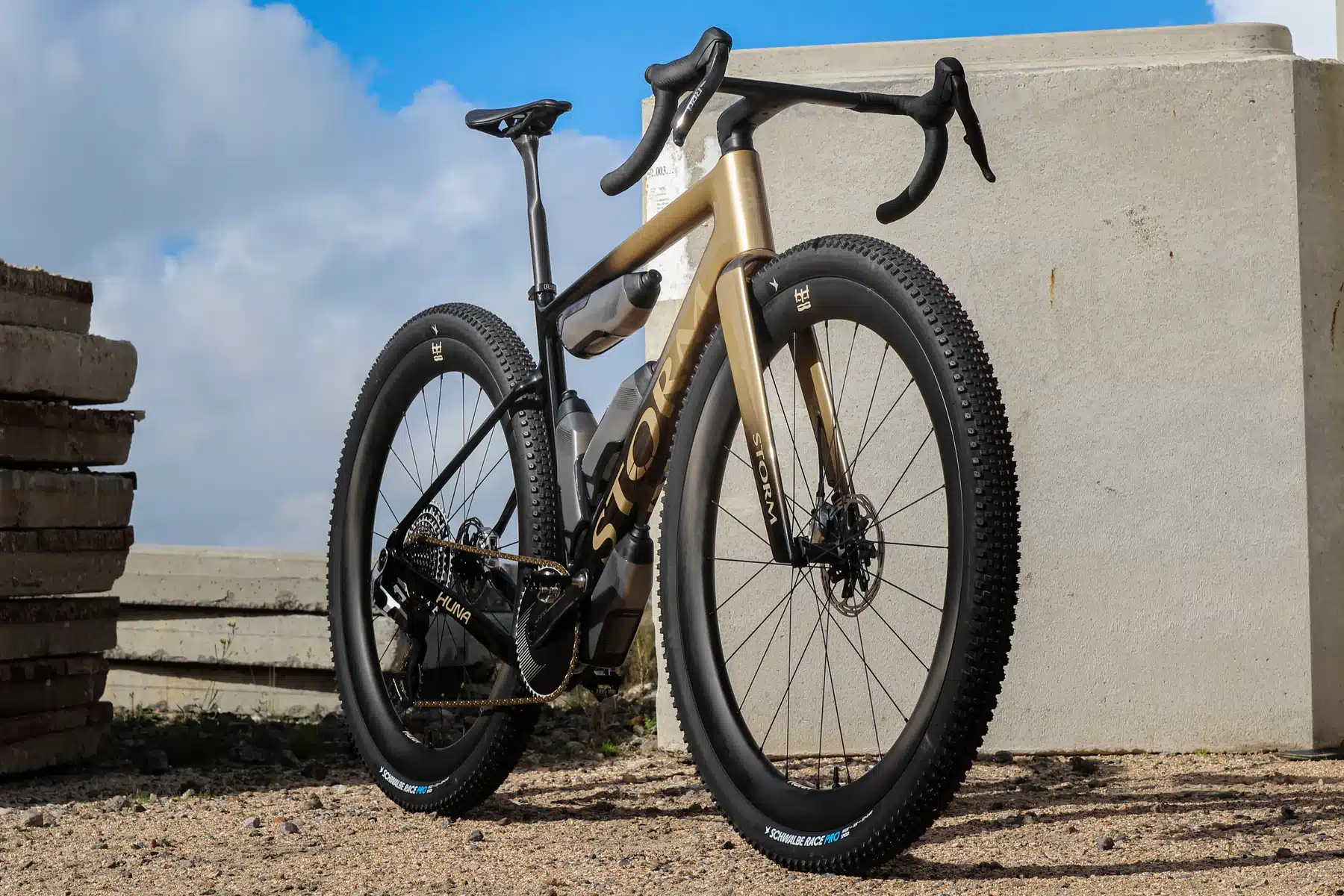
Our development partner Storm Bikes has a great deal of experience with beach bikes, and it is with them that we tested 32 inch wheels on sand. We co-developed the 52mm asymmetric carbon wheelset for their Huna 32 inch gravel and beach bike, a carbon frame designed from the start around the 32 inch wheel. It did not take long to find that the difference is easy to feel on the sand. That is a rider’s impression from pre-production sample tires, not a measurement, but it is what made us build the SandStone 32.
What 32 inch beach racing asks of you
A 32 inch wheel is heavier than a 700c wheel, as every 32 is, and it needs a frame and fork built for the size. The tire range for the size keeps growing. Schwalbe has the Rick Pro in 2.4 inch (about 62mm), a wide, high-volume tire for soft ground, and the G-One RS Pro and RX Pro in 50 and 55mm are on their way. Maxxis offers the Aspen ST, a low-profile semi-slick, in 32×2.15 and 32×2.4, and the Bikepacking.com tire list shows more models. The SandStone 32 uses the same DT Swiss 350 hubs and brass nipples as our other beach wheels, because salt and sand are the same on any wheel size. Check the tire pressure and width guide for the rim maximums; for the rest, test in steps of 0.1 bar, as the racers do.
If your frame is not ready for 32, the SandStone Boost gives you the same rim in 700c. If it is, read why the format also works on gravel in our article on 32-inch gravel wheels.
View the SandStone 32 in our webshop.


