

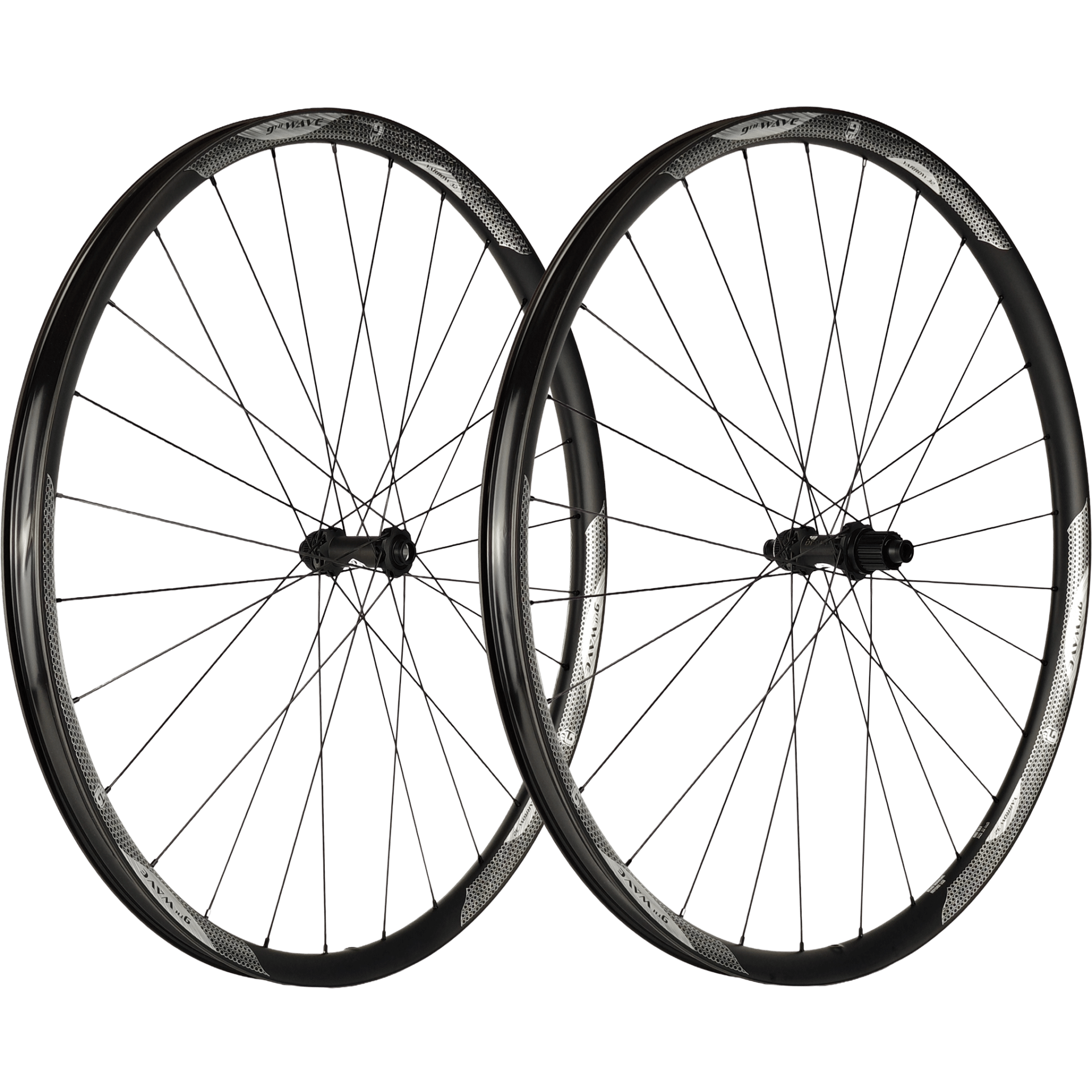
A root at speed, a line you’ve ridden a hundred times, and one moment where the front wheel catches instead of rolling through. On a 29er, that’s just part of XC racing. On a 32-inch wheel, the same root sits at a shallower angle, and the wheel is more likely to roll straight over it. That’s the real argument for going bigger, and it’s a big enough deal that the UCI has stopped capping wheel size for 2026 and teams are already testing 32 inch MTB wheels in World Cup XC.
The physics is simple, and it’s real
A wheel meets an obstacle at an angle that depends on its diameter: the bigger the wheel, the shallower that angle, and the less of your forward speed gets converted into an upward bump. That’s the same argument that took mountain biking from 26 to 29 inches two decades ago, and it holds again at 32. Riders get a longer contact patch too, which means more grip on loose, technical climbs and less energy lost fighting the terrain over a long XC or marathon effort.
The honest weight question on 32 inch MTB wheels
A bigger rim needs more carbon, and a bigger wheel needs longer spokes. Both add grams, and no wheel builder should pretend otherwise. But rim engineering doesn’t stand still. A well-built 32-inch carbon rim today lands close to where a well-regarded 29-inch race rim sat only a few years ago. Our own Yarrow SL32 rim weighs 415g, and the matching SL29 rim weighs 340g: a real difference, but a much smaller one than the jump in diameter alone would suggest. Weight isn’t a solved problem at 32 inches, but it’s a rapidly shrinking one.
The stiffness question the industry is still working through
Lateral stiffness is the harder engineering problem, and it’s worth taking seriously rather than waving away. Independent stiffness testing published by wheel component maker Newmen found that, with an otherwise identical build, a 32-inch wheel deforms roughly 31% more under lateral load than its 29-inch equivalent. Reporting from Escape Collective on prototype testing at another wheel brand found a similar 12 to 16% reduction in lateral stiffness moving to 32 inches. Longer spokes simply have more leverage against them, and there’s no way around that with the same basic components.
There are ways to claw that stiffness back, and the choices a wheel builder makes here matter. Newmen’s data shows that going from 28 to 32 spokes recovers about 11% of that stiffness, at the cost of roughly 50g. Going the other way, down to 24 spokes, saves weight but gives more of that stiffness back to the larger wheel’s longer lever arms; some 32-inch wheels on the market have made exactly that trade to hit a lighter claimed weight. We’ve chosen to stay at 28 spokes front and rear on both the Yarrow SL32 Ninefold and the Yarrow SL32, not fewer, because we’d rather keep the stiffness than chase the last few grams.
The other lever we already had available is our ART asymmetric rim design, used across the whole 9th Wave range. By offsetting the spoke bed, ART evens out the tension difference between the two sides of the wheel, which is exactly the kind of structural reserve that helps absorb the extra leverage a bigger wheel puts through the spokes. In practice, that means the lateral stiffness concerns that show up clearly on a stiffness rig are less noticeable on the trail than the raw percentages suggest.
What about 29-inch wheels?
32-inch wheels don’t replace 29ers, and we don’t expect them to any time soon, especially not on smaller frame sizes. Read our take on why 29 is here to stay in 29 vs 32 Inch MTB Wheels: Why 29ers Are Here to Stay.
Where 32 inch MTB wheels make sense, and where they don’t
32-inch wheels are for the terrain and racing they were built for: XC racing, marathon distances, set routes and mountain climbs, where the rollover, traction and momentum gains matter over hours in the saddle. They are not built for downhill or anything gravity-focused, where the added leverage on the wheel and the reduced agility in tight terrain work against you.
If your riding fits that first description, we build two versions on the same rim. The Yarrow SL32 uses DT Swiss 240 EXP hubs at 1445g: reliable, serviceable anywhere, and approved for light e-MTBs up to 250W and 32km/h. It’s also the version available with Superboost (12×157) hub spacing, alongside standard Boost. The Yarrow SL32 Ninefold goes further, with our own Onda-M hub and Sapim RC-1 fiber spokes bringing the same wheel down to 1235g.
The Yarrow SL32 isn’t only for mountain bikes, either. If your 32-inch gravel bike takes Boost or Superboost hub spacing, the Yarrow SL32 gives you a lower rim profile and a lighter build than the SandStone SL32, our dedicated 32-inch gravel platform: 415g rim and 1445g for the set here, against 470g and 1579g for the deeper, wider SandStone SL32. Which one suits you depends on what your riding calls for: a shallower, lighter wheel here, or the aero-focused depth of the SandStone SL32 for fast, open gravel.


