

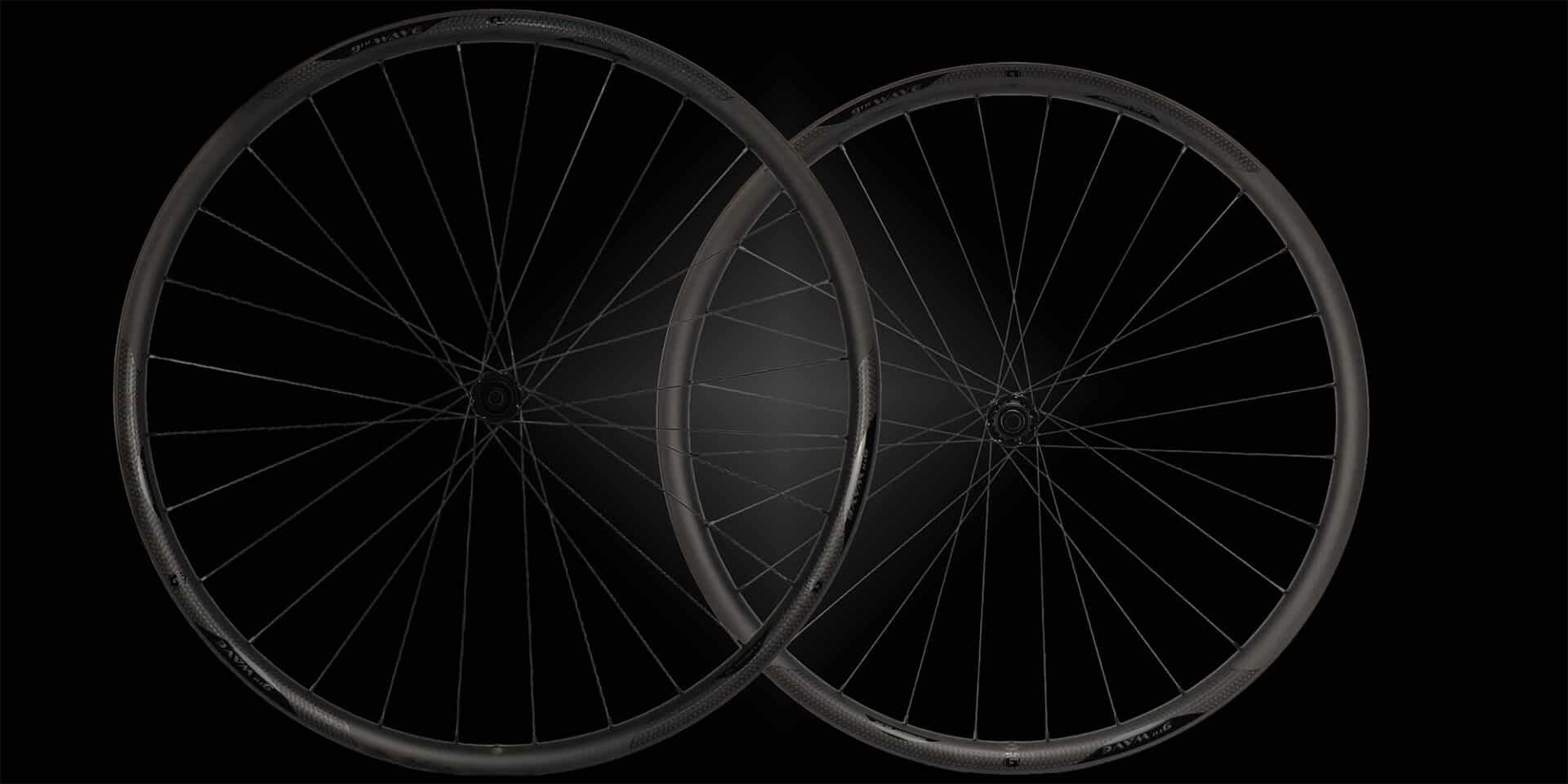
You have seen 32-inch wheels turn up on XC race bikes, and now you are about to order a new wheelset. The question that decides it is not which size rolls over a root better. It is whether your frame was designed around that size, and what the extra diameter costs you in grams. That is the real question behind 29 vs 32 inch MTB wheels.
The short answer on 29 vs 32 inch MTB wheels
If your frame was designed for 29-inch wheels, stay at 29. A 32-inch wheel only fits frames developed for it, and in our opinion it makes the most sense from size M or L upward, for riders who race XC or marathon on routes where rollover and momentum matter more than agility. In our own range the step from 29 to 32 inches adds 150 g on the standard builds (1295 g to 1445 g) and 170 g on the Ninefold builds (1065 g to 1235 g). The rim is 32mm internal width at both sizes.
Where this started
In 2017, before wide rims were the obvious choice in mountain biking, we launched the original Yarrow 29 at 29mm internal width. It was not an instant bestseller: it took years, and the rest of the industry catching up, before wide became the standard. The same thinking sits behind the 32mm internal width we use today on both wheel sizes. It is wide enough to support modern XC and marathon tires properly, without going further than those tires ask for.
What 32 inches costs in grams
A bigger rim needs more carbon and a bigger wheel needs longer spokes. Our Yarrow SL32 rim weighs 415 g and the SL29 rim 340 g, so the rim accounts for most of the difference you see on the scale. Here are the four builds side by side:
| Wheelset | Wheel size | Weight | Spokes (front / rear) | Hub |
|---|---|---|---|---|
| Yarrow SL29 | 29″ | 1295 g | 28 / 28 | DT Swiss 240 EXP |
| Yarrow SL32 | 32″ | 1445 g | 28 / 28 | DT Swiss 240 EXP |
| Yarrow SL29 Ninefold | 29″ | 1065 g | 24 / 24 | Onda-M |
| Yarrow SL32 Ninefold | 32″ | 1235 g | 28 / 28 | Onda-M |
Look at the spoke counts. On the standard builds both sizes use 28 spokes, so the 150 g is the bigger wheel itself. On the Ninefold builds the 32-inch wheel also carries four extra RC-1 spokes per wheel, so part of the 170 g is a choice rather than a physical necessity. We made it because lateral stiffness is the hard problem at 32 inches: longer spokes have more leverage against the rim, and we would rather keep that stiffness than chase the last grams. The full reasoning is in our article on 32-inch weight and stiffness.
Frame size decides which wheel makes sense
A 32-inch wheel only fits frames that were developed for 32-inch wheels. For most riders the choice is therefore already made by the bike they own. If you are choosing a new frame, it is our opinion that 32 inches makes more sense on larger sizes, and that the tipping point lies around size M or L. On those sizes a bigger wheel fits the geometry naturally. Frames in large sizes are already coming to the market. We have no doubt the bike industry will also optimise smaller frames for 32 inches, just as it eventually did for the 29er, but until that happens a 29 remains the better fit on small frames. It also stays more agile in tight, technical terrain, and the tires, parts and know-how around it are everywhere.
Choose 29 if your frame is designed for it, which is still the case for most frames, or if you ride in tight technical terrain. Choose 32 if your frame is designed for it and your racing is long XC or marathon routes, where holding speed over roots and rocks pays back for hours. Either way, the build follows the same thinking: 32mm internal, an ART asymmetric rim, and either DT Swiss 240 EXP hubs or our own Onda-M hub on the Ninefold builds. They are made for XC, marathon, trail and light bikepark use, not downhill.
Frequently asked questions
Is the 29er obsolete now that 32-inch wheels exist?
No. Most frames are still designed around 29-inch wheels, and a 29er remains the better fit on smaller frames and in tight technical terrain. 32 inches will take real space on larger frames, but for now it adds a size rather than replacing one.
Which frame sizes suit 32-inch wheels?
In our opinion, size M or L and up. Frames in large sizes are already appearing, and we expect the industry to optimise smaller frames for 32 inches too, as it did for the 29er. A 32-inch wheel only fits frames developed for it.
How much heavier is a 32-inch wheelset than a 29-inch one?
In our range, 150 g on the standard builds (1295 g versus 1445 g) and 170 g on the Ninefold builds (1065 g versus 1235 g). The Ninefold 32 also runs 28 spokes instead of 24 to keep lateral stiffness.
Is the rim width different between 29 and 32?
No. Both the Yarrow SL29 and SL32 lines use a 32mm internal width, tuned for modern XC and marathon tires.
Ready to choose? View the Yarrow SL29 or the Yarrow SL32 in our webshop.


