


Forty kilometres in, the road turns to patched tarmac. Your hands buzz, your lower back starts to complain, and the bike skips over every seam instead of rolling through it. You did not lose fitness in the last ten minutes. You are riding a narrow tire at a pressure that suits a velodrome, not this road. This is the situation where wider road tires earn their place on a road bike.
Why wider road tires can roll faster
At the same pressure, a narrow tire makes a long, thin contact patch, and a wide tire makes a shorter, broader one. The casing of the wide tire flexes less at every turn of the wheel, so less energy disappears as heat. That is the mechanical reason wider tires can match or beat narrower ones, and it is why they let you run a lower pressure without giving up speed.
Recent lab data backs this up. In a December 2025 test by Bike Magazin, a 57mm tire needed about 10.3 watts at 2 bar, less than the 11.4 watts a 45mm tire needed at 4 bar. Those are gravel and touring widths, not road widths, but the mechanism is the same. In March 2026, BikeRadar reported that Hutchinson’s independent testing found a 32mm road tire rolling about 5% more efficiently than its 30mm sibling. That test was commissioned by the tire maker and the article gives no details on the method, so read it as an indication, not as proof.
Why we always advise wider and a little lower
Cyclingnews tested 26 to 40mm tires at the Silverstone Sports Engineering Hub in March 2025. On cobbles, the wider tires saved more than 50 watts at typical racing speeds. On smooth tarmac the narrow tires kept an advantage, because a wider tire costs some aerodynamic drag, and that grows with speed. The catch is the word smooth. Tarmac that is smooth enough for a narrow, hard tire to win only really exists on a velodrome or in a test rig. Every road you actually ride has seams, patches, cracked edges and worn surface, and that is where a narrow tire at high pressure starts to bounce and lose energy.
That is why our advice does not depend on the road: go wider, and run a slightly lower pressure than you are used to. Professionals have moved the same way. BikeRadar measured the tires at the 2026 Tour de France and found an average width of 30.29mm, with almost half of the sample on 30mm tires and only one in 26 on 25mm.
The rim matters as much as the tire
A wide tire on a narrow rim bulges into a bulb shape, which costs you cornering feel and smooth air flow around the wheel. The same BikeRadar article ties the shift in tire width to wider rims, with internal widths of 22 to 25.4mm now normal at the Tour. The rim is designed around the tire, not the other way around.
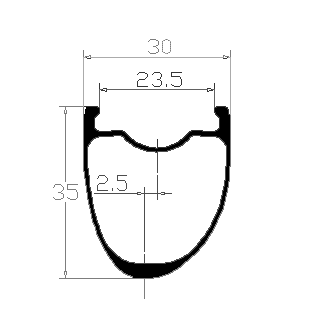
Our current road rims follow that logic. The Avalon SL3 and Avalon SL5 both have a 23.5mm internal width, hooked and tubeless ready, and are rated for 27 to 33mm tires. We recommend 28 to 30mm: enough volume and grip to ride at a lower pressure, narrow enough to keep tire and rim in one smooth shape. Our Size & Pressure Chart shows the pressure to start from for your tire width and weight.
Which wheel for which road
If your rides are mostly long climbs and you want the lightest wheelset that still takes a 30mm tire, the Avalon SL3 is the one. The rim is 35mm deep at the front and 40mm at the rear, and the set weighs 1248g. Every gram you take off a wheel matters most when the road tilts up, as we show in our article on wheel weight on the climbs.
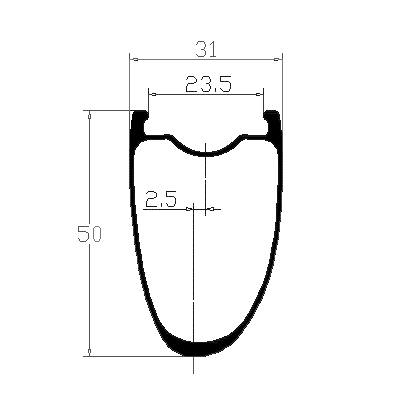
If you ride fast on flatter, more exposed roads, the Avalon SL5 is 50mm deep at the front and 55mm at the rear, with a set weight of 1357g. The shallower front keeps the bike calm in a crosswind while the deeper rear adds lateral stiffness when you sprint. We explain the stagger in why the Avalon SL5 runs mixed depth. For riders who want the lightest build, the Avalon SL3 Ninefold and Avalon SL5 Ninefold use carbon spokes and our own Onda-R hubs with ceramic bearings.
What to take from this
Start with a 28 to 30mm tire on a rim built for it, take a little pressure out, then change it in small steps and feel the difference on your own roads. Our article on endurance road wheels with wider tires at lower pressure shows how this works in practice.
View the Avalon SL3 or the Avalon SL5 in our webshop.


